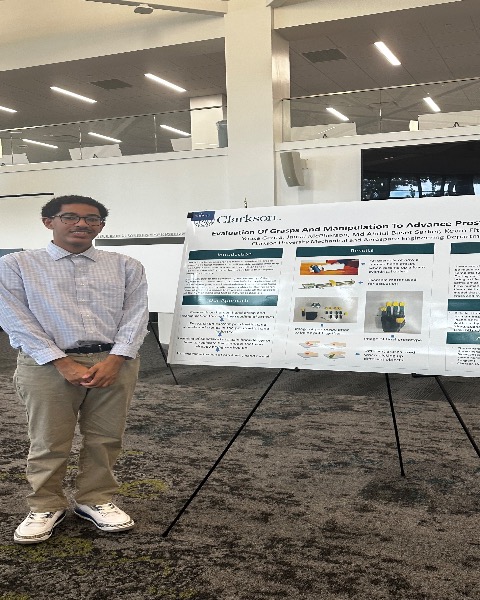
Introduction: Human hands are capable of performing various tasks all while using different grasps and manipulations. But what if you were born without those hands as a result of a congenital disorder or lost them due to a traumatic event? For a long time, researchers have been working on creating approaches that could one day hopefully solve this issue. Although advancements have been made, current models often struggle to mimic the dexterity and adaptability of the human hand. The research I have been working on paired with my work on solidworks aims to strengthen the viability of prosthetic hands by investigating the different grasps and manipulations that humans use on a day-to-day basis, thus creating a product that will feel as natural as possible to the human hand and possibly replicate this model in the future. The project involves constructing a hand model with strings running through the fingers, connected to a motor for actuation. Our findings so far suggest that the string-based prosthetic hand model we are working on provides a promising approach to replicating natural hand movements. Our results highlight the potential for improvements to current prosthetic hand models and future research for new prosthetic hand devices.
Materials and
Methods: 1. Studying how human hands interact with every day objects using different grasps and manipulations.2 research of current of current prosthetic hand models that are currently in the market.3.learning to use solidworks to be able replicate current model that is being worked on. 4.assembling current model and figuring out methods for actuation.
Results, Conclusions, and Discussions: At the moment our results are inconclusive. however our research so far suggests that current models fail to replicate the dexterity of the human hand and there is still a long way to go in regards to making a device that will allow for maximum functionality whilst also feeling as natural as possible.We believe that our research is heading in a direction where we can create a prototype that will mimic our human hands.
Acknowledgements (Optional): The research presented was supported by the National Institute of Biomedical Imaging and Bioengineering of the National Institutes of Health under award number R25EB033080 (ESTEEMED BOREALIS Scholars Program) •Clarkson University Ignite Maker Space Lab I would also like to acknowledge Jamal McPherson, Md Abdul Basel Sarker,Kevin Fite,PhD Clarkson University Mechanical and Aerospace Engineering Department